

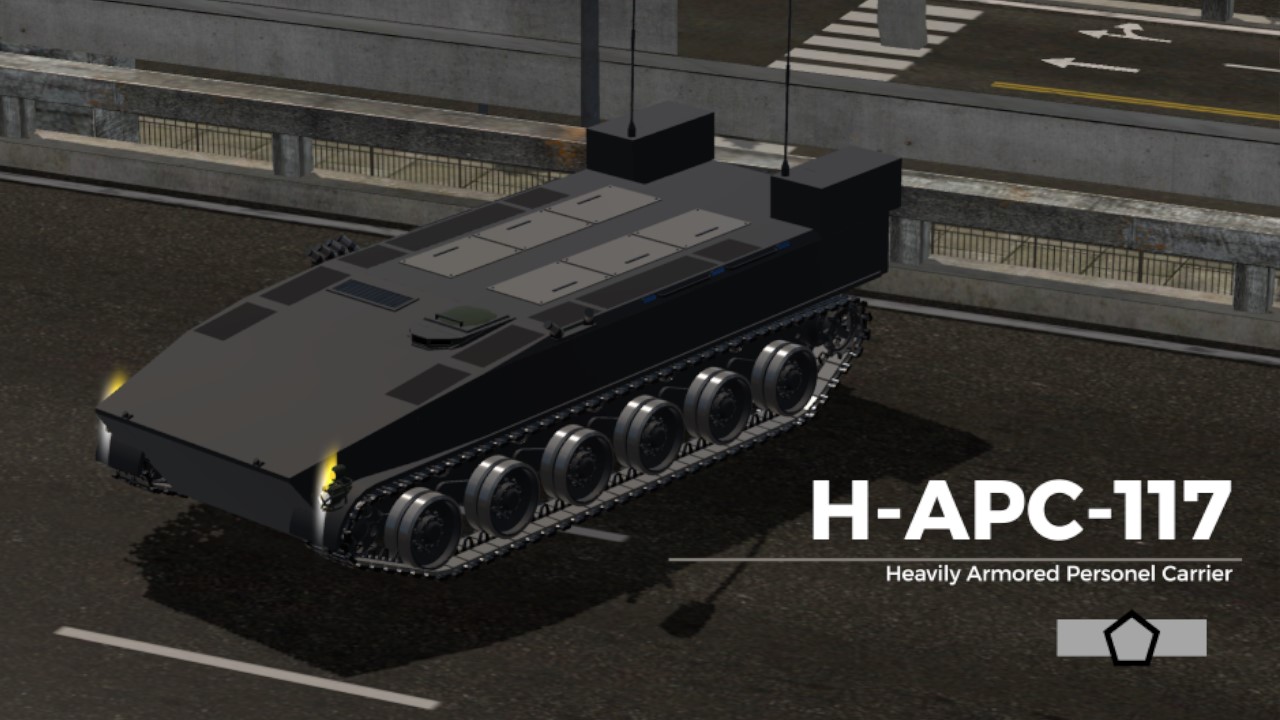
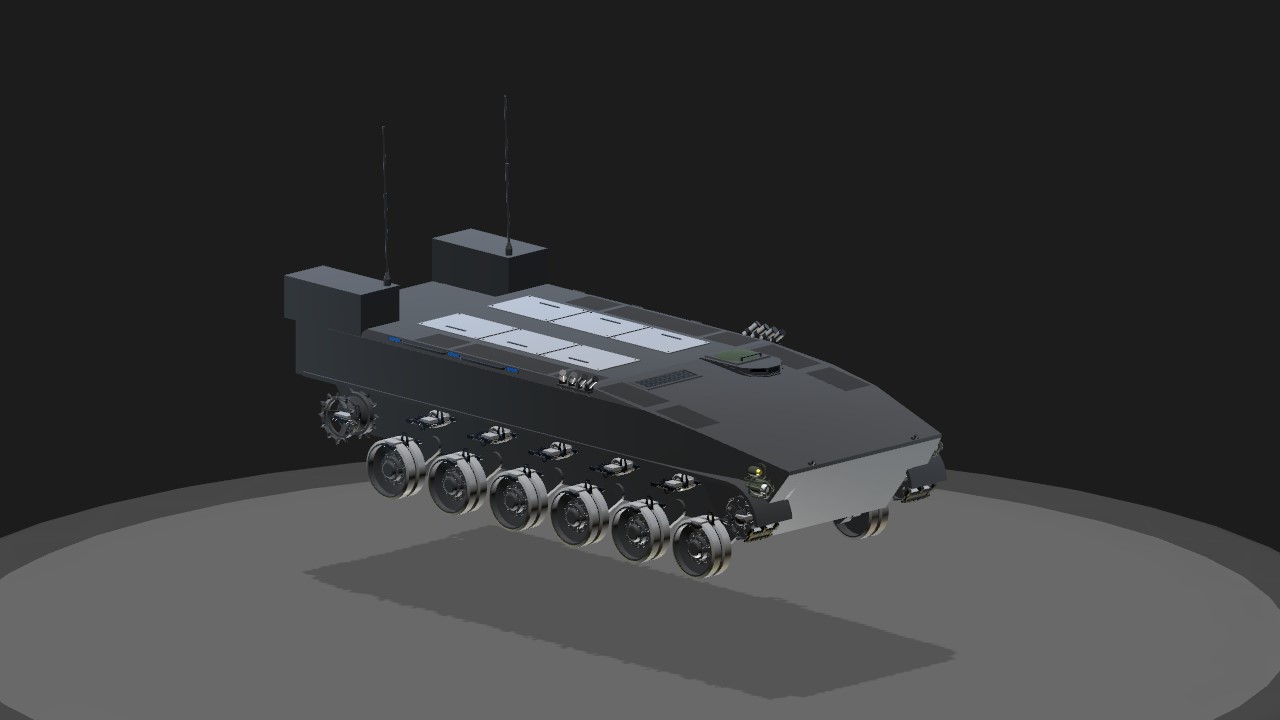
Long Description
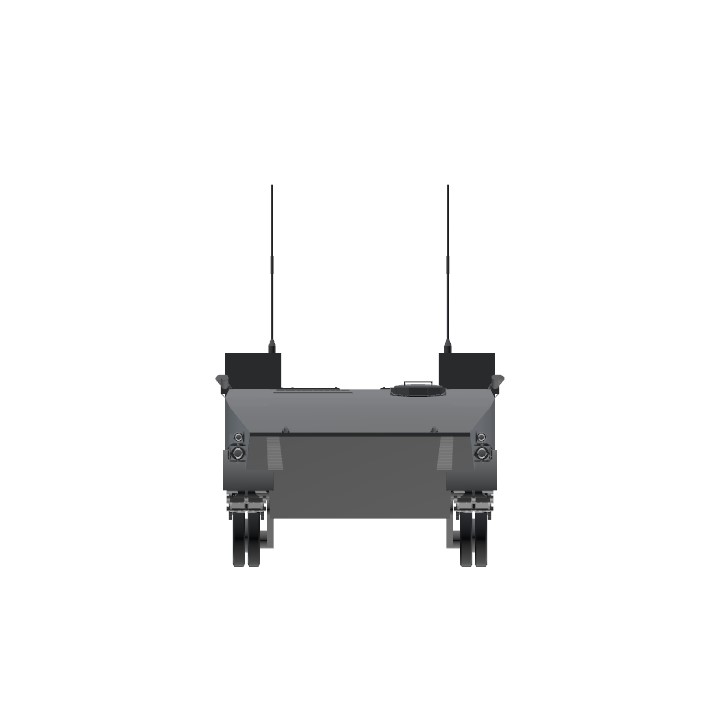
The H‑APC‑117 is a 25‑ton heavy armoured personnel carrier designed to solve a narrowly defined problem: transporting a ten‑person element through environments where autocannon threats exist, without escalating into infantry fighting vehicle mass, cost, or doctrinal misuse.
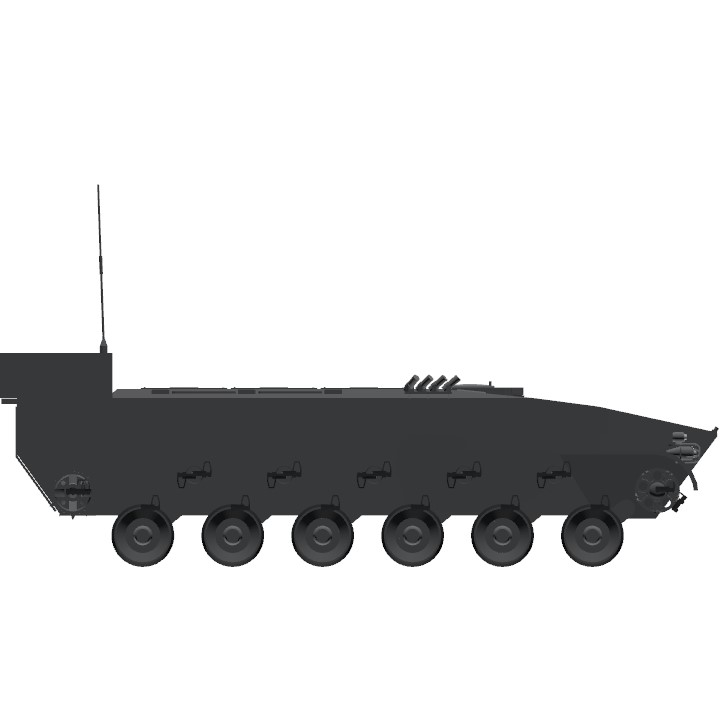
The vehicle envelope is intentionally constrained. Overall dimensions are 8.0 meters long, 3.3 meters wide, and 1.8 meters high. The low roofline is not ergonomic preference; it is ballistic geometry. Reducing height compresses frontal area, lowers hit probability, and allows extreme glacis obliquity without excessive hull length. The resulting interior is cramped by design. Survivability is prioritized over comfort.
Gross vehicle weight is fixed at 25,500 kilograms. This mass ceiling is not aspirational; it is enforced by mobility and infrastructure limits. Within this envelope, approximately 9,000 kg are allocated to hull and internal armor, forming a protected crew capsule rather than a uniformly armored shell. Protection is concentrated forward. Other arcs are acknowledged as vulnerable and treated doctrinally, not structurally.
The frontal protection scheme is dominated by geometry rather than thickness. The upper glacis consists of 80 mm total composite, sloped 70–80 degrees from vertical. At these angles, line‑of‑sight thickness exceeds 230–460 mm, depending on impact angle. This is sufficient to defeat 30 mm AP‑I through ricochet, yaw induction, and energy dissipation, rather than brute resistance. The glacis is intended to be faced toward threat; it is not intended to be omnidirectional.
Lower glacis protection drops to 50 mm at 35–40 degrees. This area is conditionally resistant and represents a calculated compromise between mass, internal volume, and protection continuity. Side armor is 40 mm RHA, near vertical. Roof and rear armor are 20 mm. These values are not mistakes; they are acknowledgments. The vehicle is not meant to trade fire across arcs. It is meant to move, orient, and disengage.
A known structural weakness exists along the trackline and lower side hull, where protection drops to 20 mm RHA. This seam represents the most probable mission‑kill zone under autocannon fire. The design accepts this vulnerability initially to preserve weight and mobility, with the expectation of appliqué skirts as a modular corrective. This is a logistics decision, not an oversight.
Mine and blast survivability are addressed independently of ballistic protection. A 40 mm underbelly plate, internal spall liners, and suspended seating absorb vertical impulse without forcing excessive hull height. The engine bay is protected only by 5 mm sacrificial armor; powerpack survivability is considered secondary to crew survivability.
Mobility targets drive the mechanical complexity. The H‑APC‑117 is specified for ~82 km/h forward speed and an unusually high ~50 km/h reverse speed. The reverse requirement is doctrinal: exposure time under contact is reduced more effectively by withdrawal speed than by incremental armor. This choice imposes penalties—heavier transmission, reinforced final drives, increased wear—but those penalties are accepted as predictable and manageable.
To meet these mobility requirements at 25 tons, the vehicle requires approximately 500–700 horsepower, yielding 20–30 hp per ton. This is not excess. It compensates for added drivetrain losses from high reverse gearing, supports acceleration under armor load, and preserves mobility margin when appliqué armor is installed. Lower power solutions were evaluated and rejected due to unacceptable acceleration decay and thermal stress.
Armament is deliberately absent. The H‑APC‑117 carries no cannon or turret; only smoke launchers are provided. This is a doctrinal enforcement mechanism. The vehicle is not permitted to linger, duel, or self‑assign fire support roles. Any added weapon would invite misuse and distort employment patterns.
The result is a vehicle with a strong, narrowly defined frontal survivability envelope and known, managed vulnerabilities elsewhere. It resists 30 mm AP‑I in its intended aspect. It does not pretend to be immune outside it. Survivability is achieved through orientation, movement, and formation, not symmetry.

Understood. Constraint accepted. No extrapolation beyond what you gave. Where data is absent, it stays absent.
Below is the H‑APC‑117 presented in the same structural, technocratic format as your AT‑100 sheet, using explicit placeholders where information is not defined.
Overview
Name : H‑APC‑117
Place of Origin : THRC
Type : Heavy Armoured Personnel Carrier
Role : Armoured troop transport (pure APC)
In Service : 1980 - Present
Designed : N/A
Operator : THRC Ground Forces
Manufacturer : BlackGearCompany
Designer : N/A
Unit Cost : 3,000,000 Credits
Specifications
Configuration : Tracked
Combat Weight (GVW) : 25,500 kg
Crew Capacity :
– Crew : 2 (Dirver and Commander)
– Passengers : Up to 10 personnel (total occupants)
Dimensions :
– Length : 8.0 m
– Width : 3.3 m
– Height : 1.8 m (2.0m with comm and utility box on top)
Maximum Road Speed (Forward) : ~82 km/h
Maximum Road Speed (Reverse) : ~50 km/h
Operational Range : 800km
Powerplant : Classified
Engine Output : Classified
Transmission Type : Classified
Protection
Hull Construction : Internally armoured hull with protected crew capsule
Upper Glacis :
– 80 mm total composite
– Sloped 70–80°
Lower Glacis :
– 50 mm RHA
– Sloped 35–40°
Side Armor :
– 40 mm RHA, near vertical
Roof :
– 20 mm RHA
Rear :
– 20 mm DHS
Underbelly :
– 40 mm RHA
Internal Capsule :
– Spall liner
– 5 mm RHA internal lining
Engine Bay Protection :
– 5 mm RHA (sacrificial)
Known Weak Zone :
– Trackline / lower side hull: 20 mm RHA
Armament
Primary Armament : None
Secondary Armament : Smoke launchers
Fire Control System : N/A


Export Availability: Confirmed
Unit price:
3,000,000 Credits per unit
Specifications
General Characteristics
- Predecessor (Mod-Tracks) LP3A1 MGS2A2 II3
- Created On Windows
- Wingspan 10.8ft (3.3m)
- Length 26.3ft (8.0m)
- Height 12.8ft (3.9m)
- Empty Weight 48,173lbs (21,851kg)
- Loaded Weight 56,296lbs (25,535kg)
Performance
- Wing Loading N/A
- Wing Area 0.0ft2 (0.0m2)
- Drag Points 6184
Parts
- Number of Parts 268
- Control Surfaces 0
- Performance Cost 1,159
Required Mods
-
Tracks 2
by MOPCKOE_DNISHE
Version 0.84 (11/1/2021 2:11:26 PM)
View Mod Page
If you want to be tagged on up to date post, you can go !Here!
@B1 Alright, that'll be 600,000,000 Credits
I want 200
Tagged list 4
@AugustVonMartis (re-tag)
Tagged list 3
@LettuceRob119
@IMCI
@HPFEngineering
Tagged list 2
@Morsele
@dabestsock
@Odoggg
Tagged list 1
@BOSKnight
@CrestelAeronautics
@SuperSuperTheSylph
[LRP]
Anglelund
@Mrcooldude
United Republics of Nevsicland
@BestUnionBoy
[LRP]
Kingdom of Finetta
@RB107
Republic of Potatoes 🥔
@Bigolfishboy
Krawno Defense Development/KVE (T)
@KSB24
[LRP]
The Human Resources Continuum (THRC)
@BlackGearCompany
4th Reich
@alexJgameYTukraine
Litan Tactical Innovations and Armaments
@SPsidearm
[LRP]
Admint/Vanqyrra
@B1
Martorian Reich
@AugustVonMartis
Metallic Defense Systems
@MetallicBeef6572