

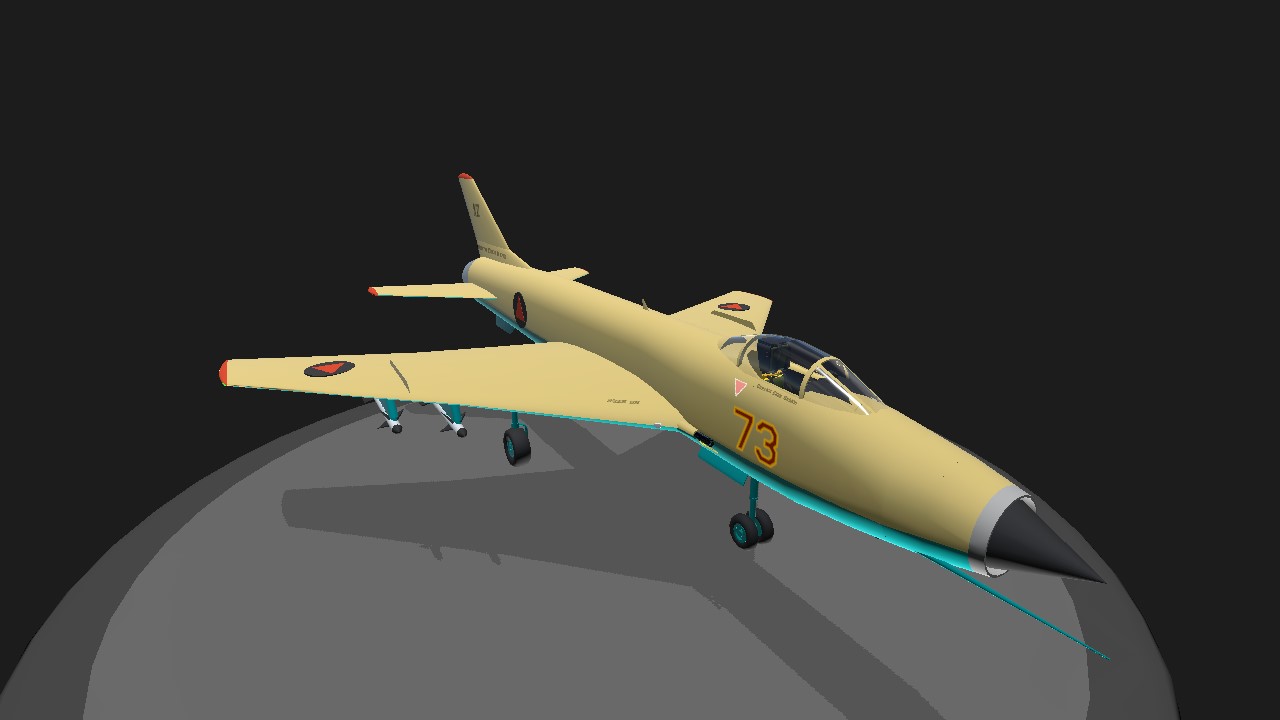

Dekara KP-12
The Dekara KP-12 Onslaught is a Maywari supersonic fighter aircraft with limited all weather capability manufactured between 1956 and 1979, by the Dekara company, later absorbed into ATG industries in 1995. It first flew on 22 October 1956, entering service in February 1958 and the final variant, the KP-12DE was retired in 1997.
A total of 914 airframes including 4 prototypes were manufactured up to the year 1981. It was replaced in service by the Dekara KP-17 Kraken, deliveries beginning in 1988, phasing out the older models.
Overview:
The Dekara KP-12 can credit it's initial development to a 1951 request for a clean sheet design of a supersonic, swept wing fighter in conjunction with the primary doctrine of a developmental bias of acceleration and climb rate introduced in all Maywari designs since the Dekara KP-9 of 1944.
As jet powered escort fighters were still in their infancy by 1951, the requirement was added for a small search and track radar to enable a limited degree of all weather capability to pounce enemy bombers that were considered a national threat along with smaller carrier aviation units of the Krakabloa Democratic Republic.
However, it would be another 4 years before a radar set, with a small enough dish diameter, was available.
Even then, issues plagued the set until 1957, when it was finally cleared for flights, as a short circuiting issue had lead to the radar being grounded until it was deemed safe to fly.
Therefore, the first 3 prototypes flew with concrete ballast in the nosecone to maintain the airframe's centre of gravity. The fourth prototype was effectively a pre production aircraft and received all the avionics planned for the initial batch of 120, including the radar and 2 extra pylons for AIM-9B/MRI-A1 infrared guided missiles and the ability to fit a centreline drop tank. All aircraft of the initial batch are powered by the NAMA TP-12 turbojet.
In 1963, an improved variant, the KP-12A, was proposed, this featuring a new 55° swept wing, a more powerful engine enabling Mach 2, a new radar warning receiver and radar, more powerful control surface actuators to improve handling and lastly, the ability to fire Beyond Visual Range missiles, therfore having full all weather capability.
Development began in July the same year, and the KP-12A officially entered service in December 1965. Because many of the core components of the earlier model were shared with the KP-12A, (For example, the fuselage being able to accept the newer and more powerful TP-15 turbojet) , the decision was made to strip existing KP-12 airframes to rebuild as KP-12A.
This decision was an economic one, not to be repeated later, as Maywar was still financially recovering from the Kraken Sea War of 1955. A total of 108 airframes were rebuilt to this standard along with 240 fresh from the factory, production of this variant ending in 1971.
In 1968, chaff and flare launchers were fitted, initially being done individually by unit, before becoming factory standard in 1969.
The 2 seat variant, the KP-12AT, first flew in 1964 and was produced until 1967.
Both single and twin seater variants were retired in 1970.
The KP-12B, which first flew in 1966, entering service in mid 1968, was a development of the KP-12A fitted with an updated version of the NAMA TP-15, known as the TP-15C. It also featured a new IFF system, an IRST sensor window forward of the cockpit, one of the first of it's kind and not seen in other nations such as Krakabloa until 1974.
The cockpit was redesigned for HOTAS operation, now featured zero-zero ejection seats and the radar was switched to a new solid state pulse doppler set that had a range of 50km.
Multirole capability was also much higher as the new radar set had the ability to track ground targets.
Due to the expansion in capability, 2 hardpoints were added to the wings whilst the 2 nearest to the wings were now also capable of fitting drop tanks, whilst the centreline hardpoint was also given the ability to fit a variety of targeting or ECM pods.
The KP-12B model was the first in the series to feature a retractable aerial refuelling probe.
The 2 seat version, KP-12BT, first flew in 1968 and 160 were produced until 1975 and retired from service along with the single seaters in 1983.
The KP-12C is visually identical externally to the KP-12B but the control system was swapped for fly by wire along with cockpit gauges being replaced with CRT displays, updated ballistic computers and an updated ejection seat along with integration for helmet mounted sights. This along with the 2 seater, the KP-12CT first flew in 1974,the latter becoming the KP-12D after the Military Standards Parliamentary Decree of 1975, left the KP-12CT designation obsolete.
The KP-12C was retired in 1990
Considered a new variant, the KP-12D introduced numerous subvariants to fill different roles and the standard KP-12D Entered service in 1977
The KP-12DM had its radar calibrated for maritime operations and the ability to fire MRI-AS2 Anti Ship missiles. It also featured new, anti corrosion paint to offset any damage caused by flying close to the sea, along with datalink integration with the Maywari Navy's NIADON network of radars, sonars, IRST and targeting data.
The KP-12DE was an electronic warfare variant which retained it's self defence capability. Featuring conformal jamming and ELINT pods on the fuselage along with an extra air scoop for a more powerful APU. It was designed to be used for SEAD missions in conjunction with the standard KP-12D or in an anti shipping role with the KP-12DM.
The KP-12DT is the 2 seat training model 130 being built running parallel to the single seat model's production line, based at the Dekara factory in Al Tarar Province, Maywar.
Specifications: (KP-12 initial batch 1957):
Crew: 1
Length: 52.8ft
Wingspan: 38ft
Height: 14.8 ft
Empty Weight: 12,713lbs
Loaded Weight: 24,573lbs
Maximum speed: 1049mph (TAS) at 34,000ft (ASL)
Range: 656 miles on internal fuel.
Service ceiling: 52,000ft.
AG1: Open/Close Canopy
AG2: Landing Lights
AG3: Navigation Lights
AG4: Strobe Lights
AG5: Jettison Weapons
Specifications
General Characteristics
- Predecessor !!CHALLENGE 50s JET DOGFIGHT
- Created On Android
- Wingspan 38.0ft (11.6m)
- Length 52.8ft (16.1m)
- Height 14.8ft (4.5m)
- Empty Weight 12,712lbs (5,766kg)
- Loaded Weight 24,572lbs (11,145kg)
Performance
- Power/Weight Ratio 6.036
- Wing Loading 35.0lbs/ft2 (171.1kg/m2)
- Wing Area 701.3ft2 (65.2m2)
- Drag Points 6635
Parts
- Number of Parts 260
- Control Surfaces 0
- Performance Cost 1,191


Fantastic work I really like the design and the layout of this plane and i cant wait to test it out!
@MoHoJIiT thanks so much dude, I was gonna scrap the project but I figured I'd post this one and build some lore for simpleplanes before sp2 comes out 😎
Nice work