

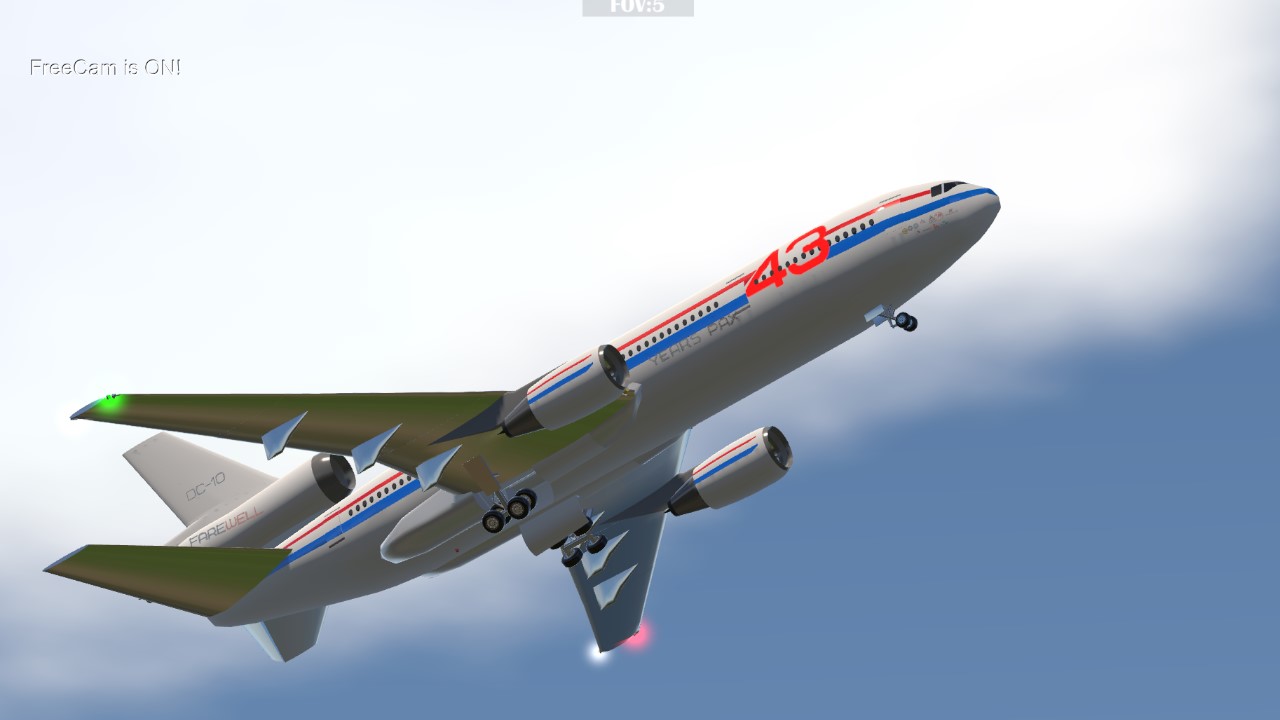
This is a fantasy livery, found on this website.
Real image (or not)
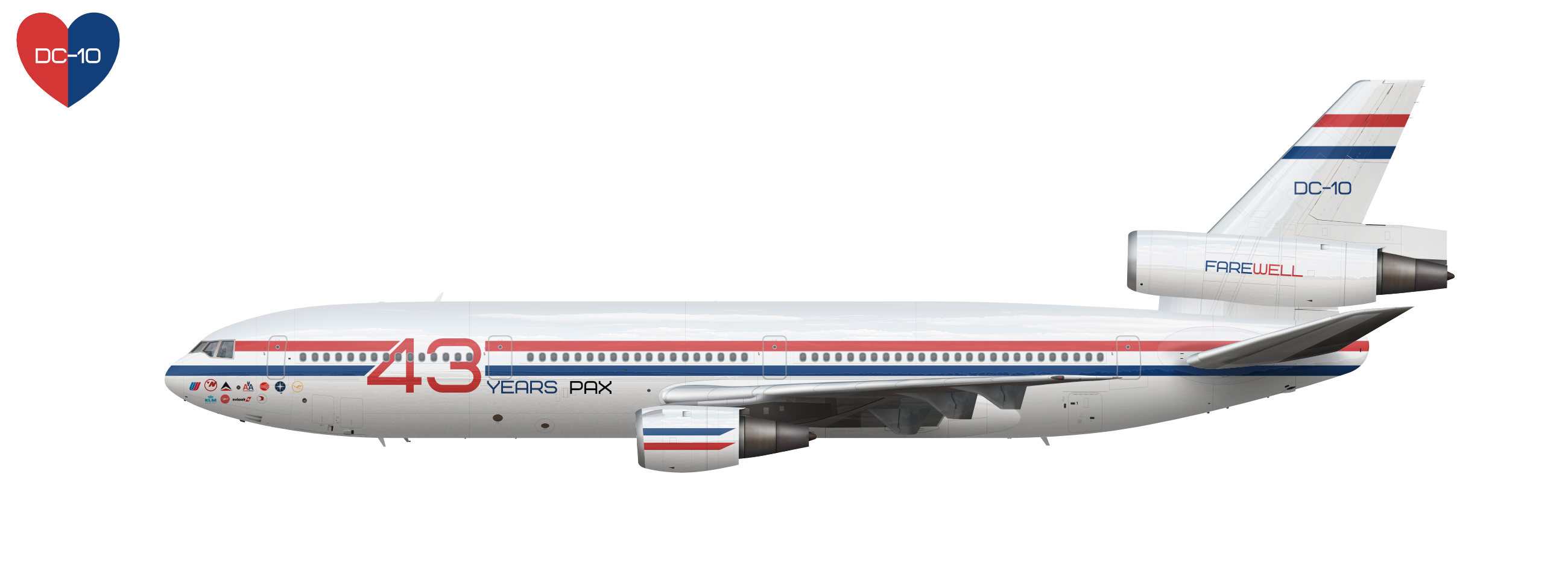
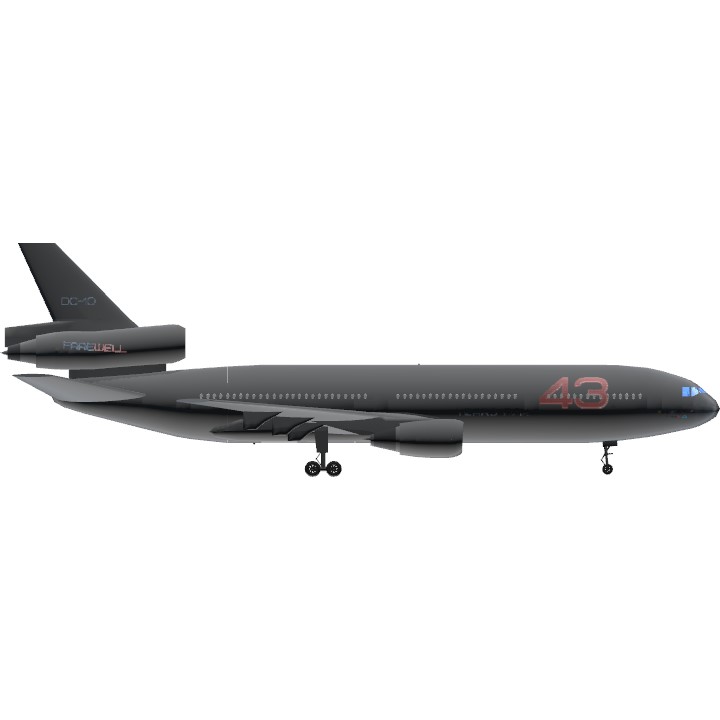
Please note that the tail is not finished (due to skill issues :)
ABOUT THE DC-10
The McDonnell Douglas (DC-10) is an American trijet wide-body aircraft manufactured by McDonnell Douglas. The DC-10 was intended to succeed the DC-8 for long-range flights. It first flew on August 29, 1970; it was introduced on August 5, 1971, by American Airlines.
The trijet has two turbofans on underwing pylons and a third one at the base of the vertical stabilizer. The twin-aisle layout has a typical seating for 270 in two classes. The initial DC-10-10 had a 3,500-nautical-mile [nmi] (6,500 km; 4,000 mi) range for transcontinental flights. The DC-10-15 had more powerful engines for hot and high airports. The DC-10-30 and –40 models (with a third main landing gear leg to support higher weights) each had intercontinental ranges of up to 5,200 nmi (9,600 km; 6,000 mi). The KC-10 Extender (based on the DC-10-30) is a tanker aircraft that was primarily operated by the United States Air Force.
Early operations of the DC-10 were afflicted by its poor safety record, which was partially attributable to a design flaw in the original cargo doors that caused multiple incidents, including fatalities. Most notable was the crash of Turkish Airlines Flight 981 near Paris in 1974, the deadliest crash in aviation history up to that time. Following the crash of American Airlines Flight 191, the deadliest aviation accident in US history, the US Federal Aviation Administration (FAA) temporarily banned all DC-10s from American airspace in June 1979. In August 1983, McDonnell Douglas announced that production would end due to a lack of orders, as it had widespread public apprehension after the 1979 crash and a poor fuel economy reputation. As design flaws were rectified and fleet hours increased, the DC-10 achieved a long-term safety record comparable to those of similar-era passenger jets. However, in November 2025, a fatal crash involving the DC-10's successor, the McDonnell Douglas MD-11, caused the FAA to ground the DC-10 again due to safety concerns.
The DC-10 outsold the similar Lockheed L-1011 TriStar due to the latter's delayed introduction and high cost. Production of the DC-10 ended in 1989, with 386 delivered to airlines along with 60 KC-10 tankers. After merging with McDonnell Douglas in 1997, Boeing upgraded many in-service DC-10s as the MD-10 with a glass cockpit that eliminated the need for a flight engineer. In February 2014, the DC-10 made its last commercial passenger flight. Its cargo service remained prevalent for a few more years until it was retired. Today only a small handful of airlines fly the DC-10, mainly for cargo and aerial firefighting.

ACCIDENTS AND INCIDENTS
As of February 2025, the DC-10 had been involved in 55 accidents and incidents, including 32 hull-loss accidents, with 1,261 occupant fatalities. Of these accidents and incidents, it has been involved in nine hijackings resulting in one death and a bombing resulting in 170 occupant fatalities. Despite its poor safety record in the 1970s, which gave it an unfavorable reputation, the DC-10 has proved to be a reliable aircraft with a low overall accident rate as of 1998. The DC-10's initially poor safety record has continuously improved as design flaws were rectified and fleet hours increased. The DC-10's lifetime safety record is comparable to similar second-generation passenger jets as of 2008.

American Airlines flight 191, one of the most famous crashes relating to the DC-10
Instructions:
Ag1 - Arm Speed brakes (requires gear down) *
*Ag2-4 - Strobe/Landing/Cabin Lights
Ag5 - Open front left door (Requires not moving)
AG6 - Pushback
AG8 - Engines, Nav/Taxi/Beacon lights
Specifications
Spotlights
- ThanhThePilot 3 hours ago
- Cellado 3 hours ago
General Characteristics
- Predecessor Douglas DC-10 (blank)
- Created On Windows
- Wingspan 165.4ft (50.4m)
- Length 181.7ft (55.4m)
- Height 59.0ft (18.0m)
- Empty Weight N/A
- Loaded Weight 136,299lbs (61,824kg)
Performance
- Power/Weight Ratio 1.364
- Horse Power/Weight Ratio 0.011
- Wing Loading 29.0lbs/ft2 (141.6kg/m2)
- Wing Area 4,700.5ft2 (436.7m2)
- Drag Points 25600
Parts
- Number of Parts 591
- Control Surfaces 9
- Performance Cost 3,246

C.C