

Hello guys, I'm back.. Yeah😛😐😜
Special Thanks to AquaViT for the Photos and RB107 for the AA!
History
On 17 September 1922, in the Indo-Pacific region, the Netherlands lost all of its combat capability in Southeast Asia. Coordinated armed uprisings across multiple territories of the Dutch East Indies forced the colonial administration to withdraw its military forces and relinquish control over the colony. In this situation, the Dutch East Indies, having lost most of its territory and military structure, ultimately submitted to a newly formed government, the Republic of the United States of Indonesia, which assumed control over nearly all assets and territories formerly held by the colonial authorities.
Following the Proclamation of Independence on 15 October 1922, Indonesia promptly established diplomatic relations with several major powers in order to strengthen its economic and military position. During the 1930s, the Indonesian government recognised that its vast maritime domain was highly vulnerable to smuggling, illegal fishing, and potential military threats from foreign powers. The naval forces inherited from the Dutch East Indies were deemed insufficient to meet these challenges.
In response, Indonesia initiated a cooperative project with the Soviet Union to construct modern capital ships. This programme, designated Project PT-14202-S, resulted in the development of the Sumatera-class battleships, a design that was exceptionally large and ambitious for a newly independent state in Southeast Asia. At the time, however, Indonesia lacked shipyards capable of constructing vessels of such scale.
Between 1931 and 1935, the government undertook extensive expansion of existing shipyard facilities. This effort demanded enormous financial and logistical resources, yet it ultimately succeeded in creating infrastructure capable of supporting heavy battleship construction. The building of the Sumatera class then commenced. Indonesia completed four units within approximately five years, while the Soviet Union constructed an additional three units in its own shipyards as part of the bilateral agreement.
When the Second World War broke out, Indonesia chose to adopt a non-aligned position and refrained from joining any military alliance. Nevertheless, military readiness was significantly increased, particularly within the Navy. Japan’s expansion into Southeast Asia, the fall of the Philippines, and the operational deployment of Japanese Yamato-class battleships placed Indonesia on a heightened state of alert.
The Sumatera-class battleships were consequently deployed actively within national waters as the primary instruments of deterrence. Japanese destroyers and cruisers were increasingly detected operating near Borneo and the Natuna Islands. The presence of Indonesian naval forces in these areas compelled Japan to act cautiously, as the Indonesian fleet was regarded as well-prepared and its capital ships notably resilient.
On 8 February 1944, a Japanese naval task force composed of cruisers and supporting vessels launched an operation aimed at seizing the Riau Islands. This operation was intercepted by an Indonesian naval force led by a Sumatera-class battleship. A naval engagement ensued and developed into an intense confrontation. Japan held an advantage in air coordination through carrier support, yet its attacks failed to penetrate the heavy armour of the Indonesian ships effectively.
In the subsequent phase of the operation, the Indonesian fleet in the Riau sector detected the approach of the Japanese battleship Musashi to a distance of approximately eighteen kilometres. The Indonesian formation maintained its position and trained its main batteries on the approaching vessel. No direct exchange of fire occurred.
After a period of observation and limited manoeuvring, Musashi and its accompanying task force altered course and withdrew from the area.
Following this incident, Japan abandoned further attempts to seize the Riau Islands and significantly reduced its naval activity in Indonesian waters. The Sumatera-class battleships continued to serve primarily as instruments of deterrence and were seldom committed to open naval engagements, functioning instead as guarantors of maritime sovereignty and regional stability.
Entering the 1950s, profound changes in naval warfare doctrine became increasingly apparent. The rise of long-range aircraft, aircraft carriers, and guided weapons gradually diminished the strategic role of heavy battleships. Although the Sumatera-class vessels remained formidable in terms of structure and armament, they were increasingly regarded as inefficient for modern warfare, which emphasised mobility and air power.
KRI Sumatera, as the lead ship of the class, was the last to be retired. After undergoing limited modernisation programmes focused on radar and communications systems, the ship was formally withdrawn from active service in 1966. Excessive operational costs and limited potential for further modernisation were the primary reasons for her retirement. Rather than being scrapped, KRI Sumatera was preserved as a museum ship and naval monument. Throughout her service life, she never sustained serious combat damage.
KRI Borneo was retired earlier, in 1962. Prolonged patrol operations in open waters had caused significant structural fatigue, rendering the vessel unable to meet safety standards without extensive reconstruction. The government elected to decommission and gradually dismantle the ship, with portions of its materials reused for shipyard and naval infrastructure projects.
KRI Nusa followed a different path. Retired in 1960, she was repurposed as a static training vessel for several years. Subsequently, the ship was employed as a target for live-fire trials involving naval and aerial weaponry, contributing to the development of new doctrines and systems. She was ultimately sunk in a controlled manner in a designated deep-water training area.
KRI Timor was the first of the class to be withdrawn, in 1958. Severe deterioration of her propulsion systems and the limited availability of spare parts rendered modernisation impractical. The ship was completely dismantled, and no intact sections were preserved.
Meanwhile, the three Sumatera-class units constructed in the Soviet Union met differing fates. Two remained in service with the Soviet Navy until the early 1950s, primarily fulfilling roles as command vessels and platforms for testing heavy-ship doctrines. However, shifts in Soviet naval strategy towards submarines and missile-based forces led to their retirement and dismantling in the mid-1950s.
The final Soviet-built unit was retained longer as a research and systems-testing vessel before being retired and scrapped in the late 1950s. None of the Soviet-built Sumatera-class ships survived intact into the modern era.
With the conclusion of their service lives, the Sumatera-class battleships came to be remembered as one of Indonesia’s most significant industrial and military achievements of the early twentieth century. Beyond their role as instruments of defence, these ships stood as enduring symbols of a newly independent nation’s capacity to establish a heavy maritime power within a complex global geopolitical environment.
Specification
2×4 380mm Main-Gun (In game 406)
2×8 150mm Secondary
4×10 30mm AA
4×4 450mm Torpedos
Width : 23m
Length : 208.6m
Height : 44m
Empty Weight : 50.341 Ton
Loaded Weight : 74.085 Ton
Max Speed : 35Knot(65kmh)
Gallery


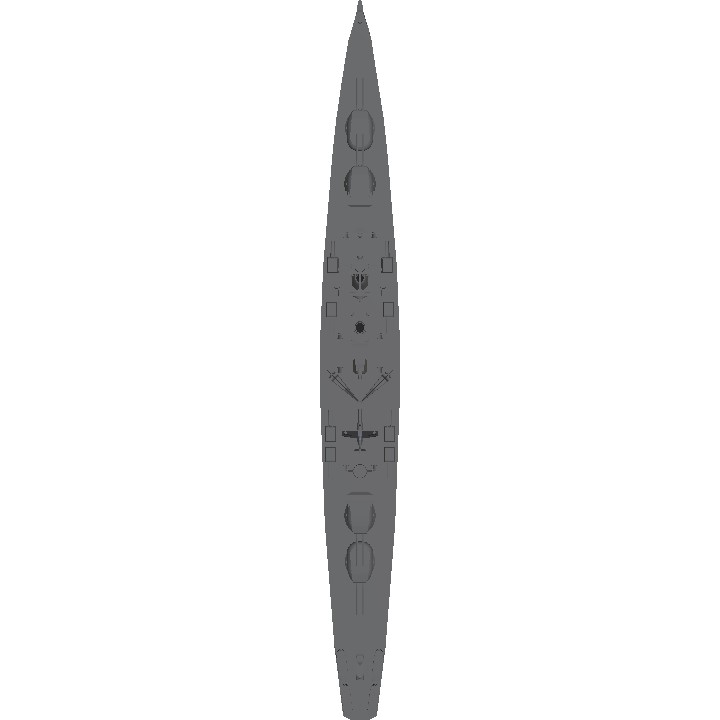
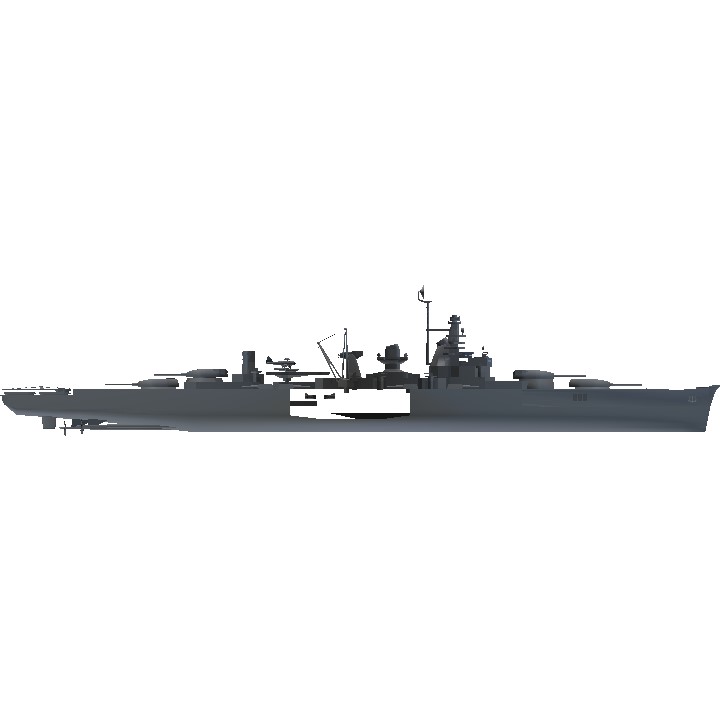
Front main

All secondaries

Rear main

In lore, this ship is powerful, but in game..


Enjoy
Specifications
General Characteristics
- Predecessor KRI Sumatera-Class (BB-202)
- Created On Android
- Wingspan 75.4ft (23.0m)
- Length 684.4ft (208.6m)
- Height 144.4ft (44.0m)
- Empty Weight 110,542lbs (50,141kg)
- Loaded Weight 162,890lbs (73,885kg)
Performance
- Power/Weight Ratio 2.483
- Horse Power/Weight Ratio 0.233
- Wing Loading 25.8lbs/ft2 (125.8kg/m2)
- Wing Area 6,322.2ft2 (587.4m2)
- Drag Points 239122
Parts
- Number of Parts 1578
- Control Surfaces 19
- Performance Cost 6,774
@tetozz I mean come on, your ship keeps exploding and that's not a problem, the dominating smoke is also not a problem, there's actually no problem in Naval except because you're just impatient in the match. By the way, I play in all modes, Ground, Aviation or Naval, I don't care. I only play War Thunder just to have fun without caring about chasing Rank, enriching coins, etc.. Not yet.
@tetozz Ofc "maybe" 😏
@Cadvalto Are you perchance one of the three people that plays naval ?1?1?1?1?11?1?
@SumateraIndustries BRING HIM HERE, I WANNA KI- Wanna play some Aviation and Continueing Naval.
@Cadvalto then gaijin will comes 🥀
Who is "nobody"? I'm playing naval and I'll be done with Myoko, then what? @SumateraIndustries
Sir, nobody plays naval...
~Hans