


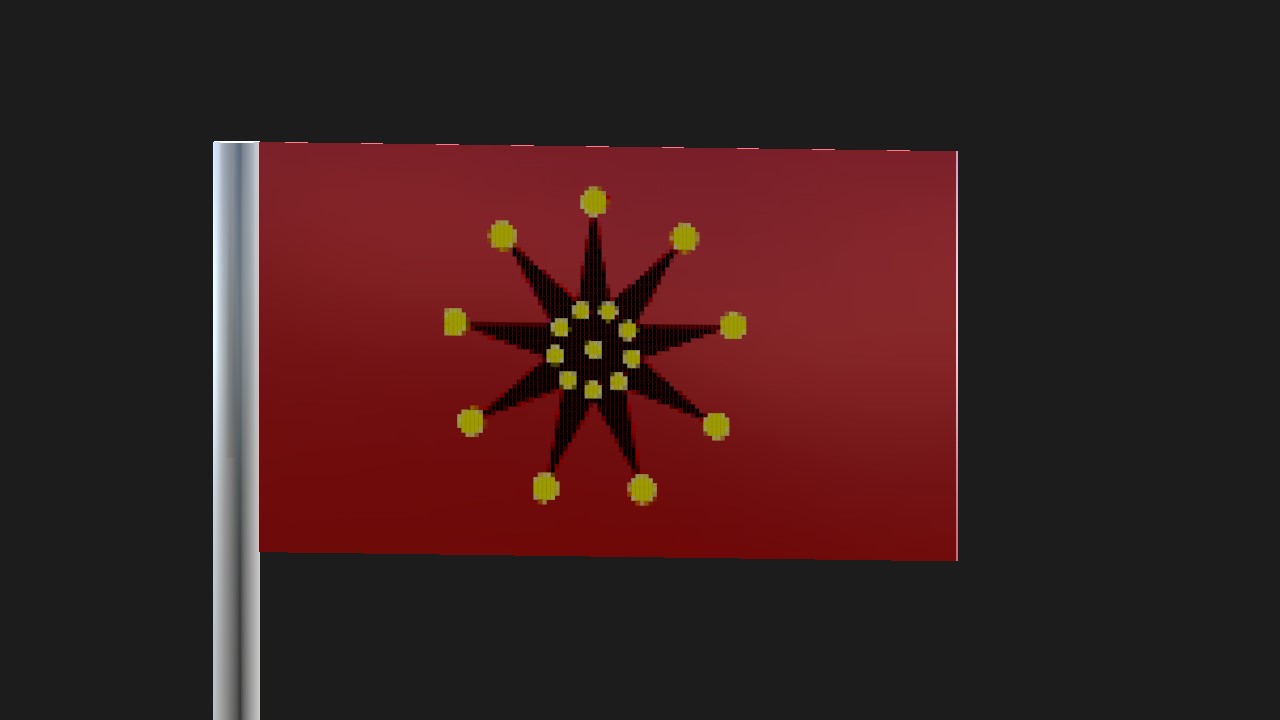
原来的旗帜/Original flag:


The Nineteen-Star Flag is a variant of the Eighteen-Star Flag.
On January 10, 1912 (the first year of the Republic of China), the Provisional Senate of the Republic of China passed a special resolution to use the 18th Star Flag as the Army Flag.
In May 1912 (the first year of the Republic of China), the Provisional Senate of the Republic of China proposed the "National Flag Unification Bill" in Beijing. The five-color flag was still used as the national flag of China, and the red flag of blue sky and white sky were used as the naval flag.
However, most legislators from the three northeastern provinces expressed opposition to the idea of continuing to use the 18th Star Banner as the army flag, because the 18th Star Banner does not include the three northeastern provinces and cannot represent the whole of China.
Therefore, lawmakers put forward suggestions on amending the 18-star flag. First, they proposed adding a larger yellow star to the center of the flag to express the unity of China. Later, it was believed that the central yellow star had the intention of focusing on the center and ignoring the local area. The central yellow star was changed to the same size as other yellow stars and became the Nineteen-Star Flag.
The proposal for the Nineteen-Star Flag was approved by the Parliament to replace the Eighteen-Star Flag
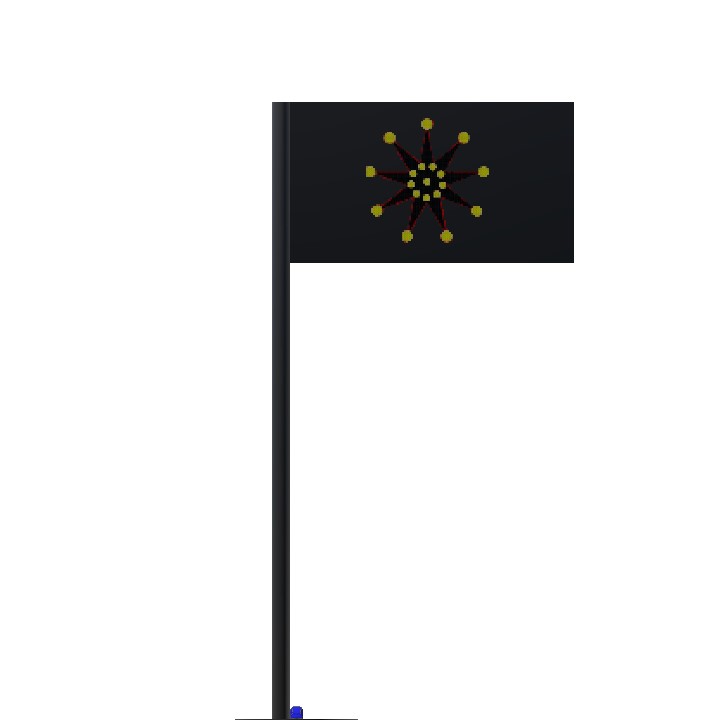
铁血十九星旗 Nineteen Star Banner of Iron and Blood:

Specifications
General Characteristics
- Predecessor Flag of China
- Created On Android
- Wingspan 56.7ft (17.3m)
- Length 16.4ft (5.0m)
- Height 95.7ft (29.2m)
- Empty Weight 3,914lbs (1,775kg)
- Loaded Weight 3,914lbs (1,775kg)
Performance
- Wing Loading 4.9lbs/ft2 (23.8kg/m2)
- Wing Area 804.6ft2 (74.8m2)
- Drag Points 17856
Parts
- Number of Parts 10
- Control Surfaces 0
- Performance Cost 23

@chineseman 天下为公 !
驱除鞑辱,复兴中华!!!