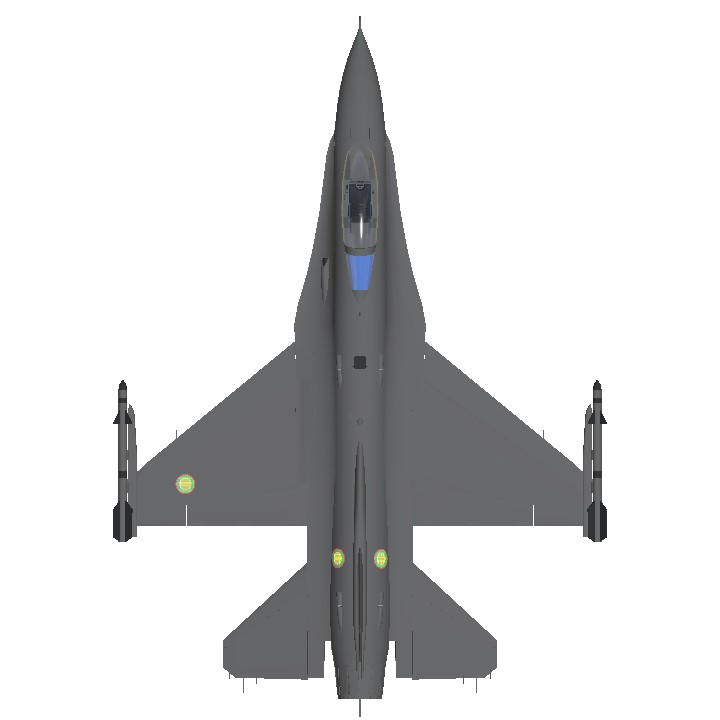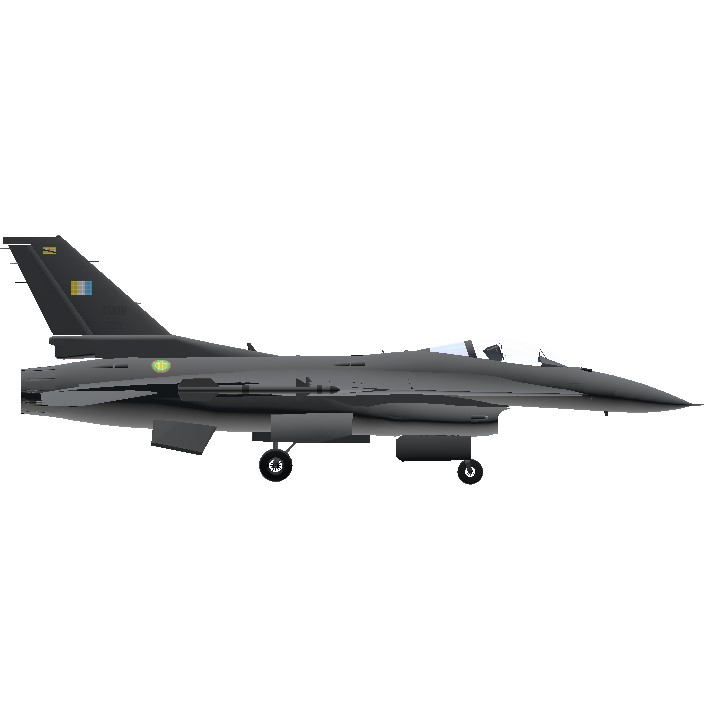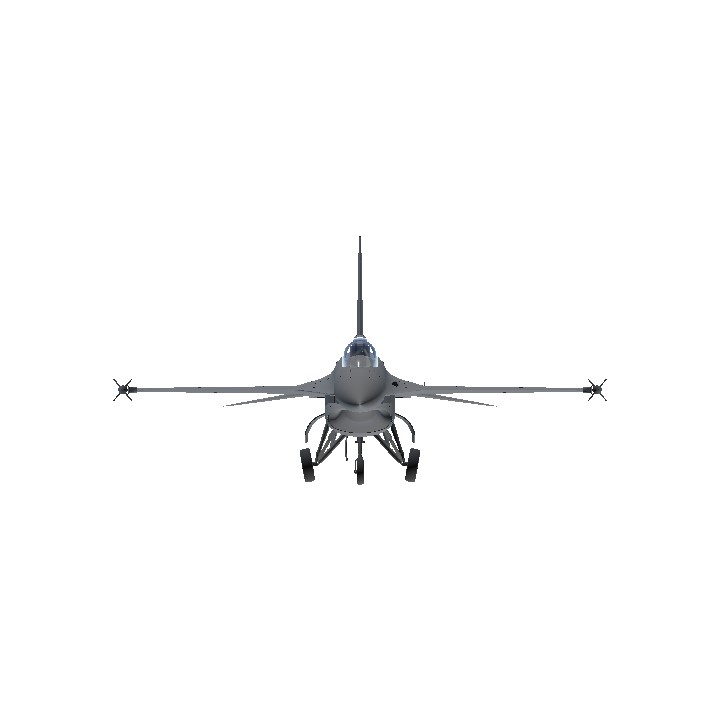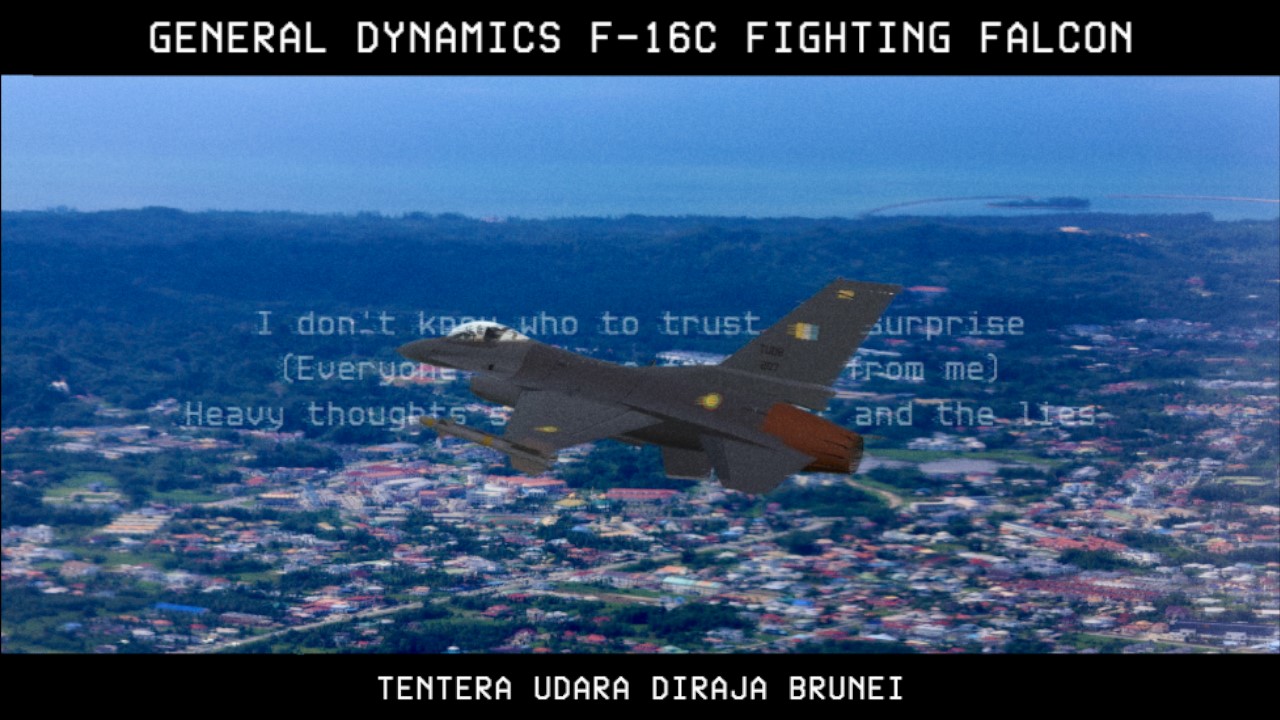
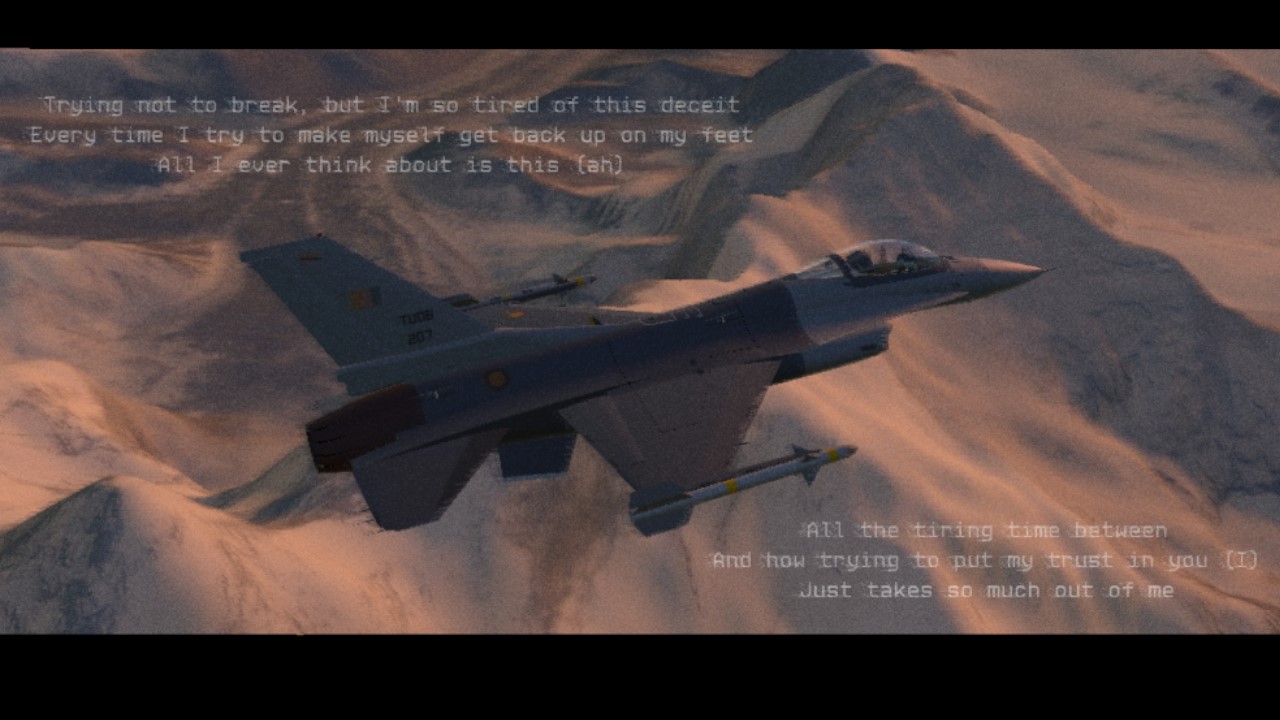
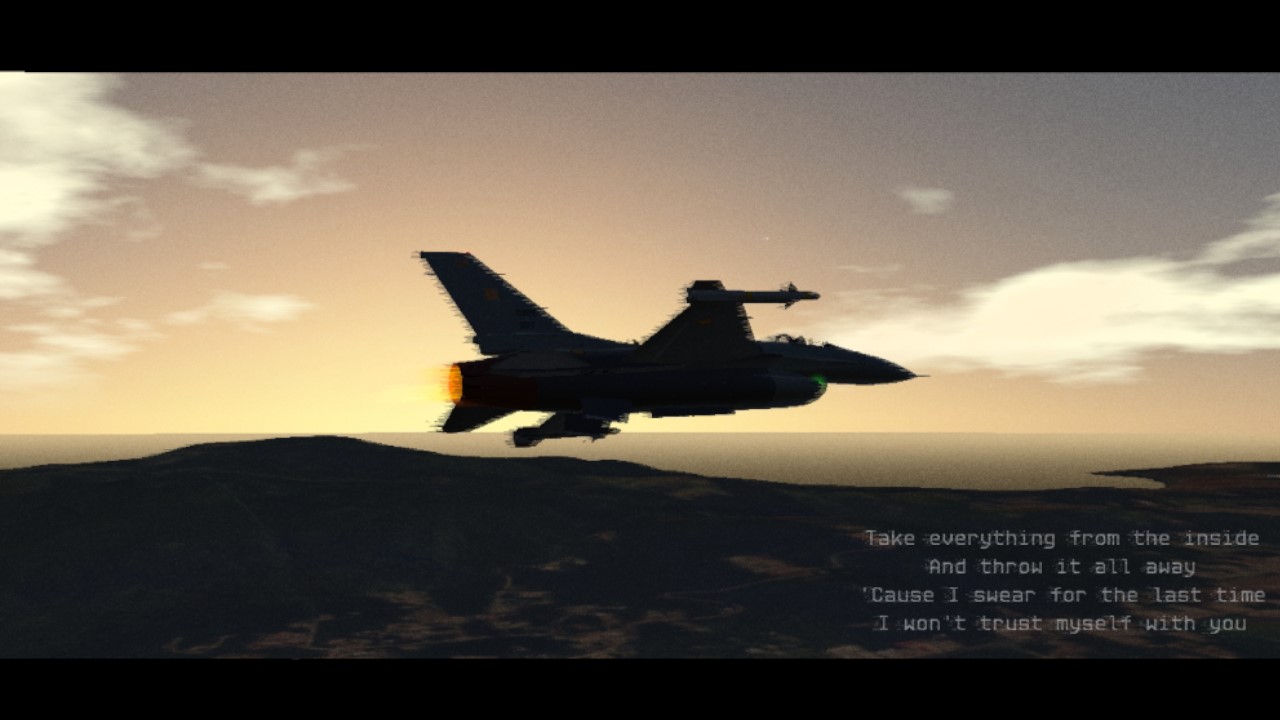
So, what if you turned QuiteInactiveWhiteBread's...
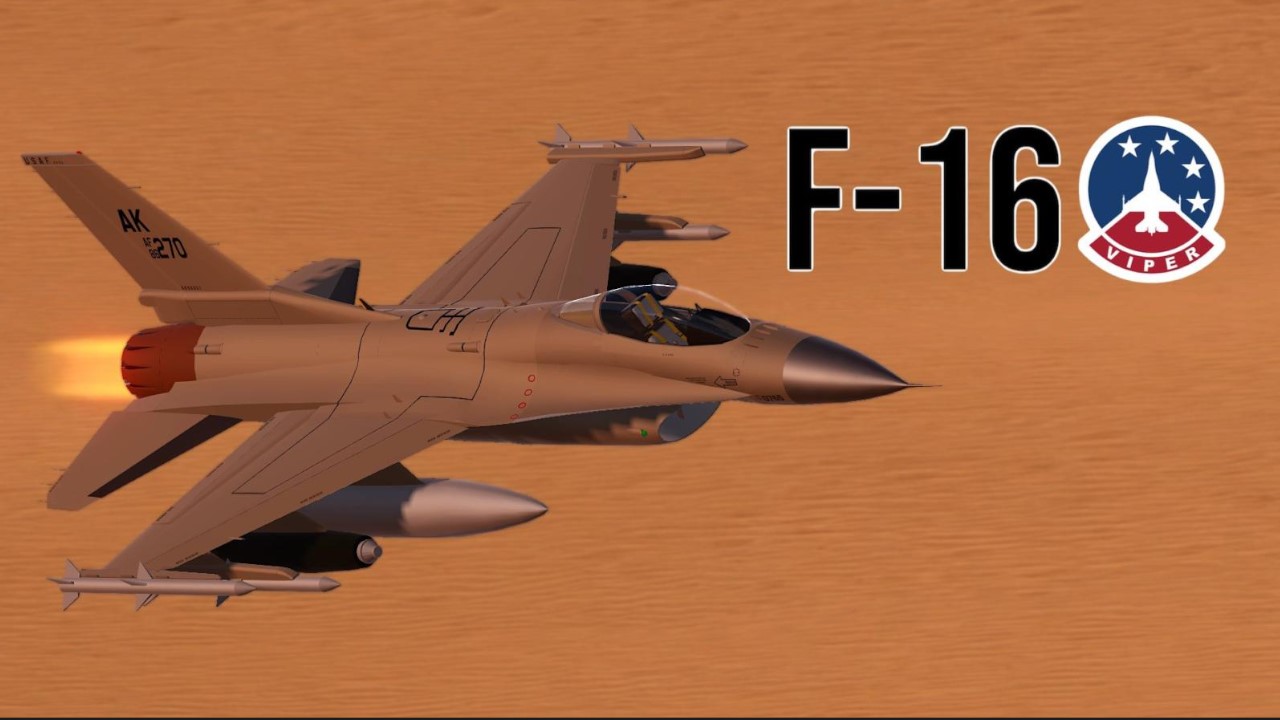
...into a Royal Brunei Air Force's aircraft?
Changes to the aircraft as follows:
- Changed the aircraft's paint colour
- Removed all hardpoints for each aircrafts (drop tanks and all weapons)
- Replaced Interceptor missiles with Guardian missiles on both wingtips (to launch missiles during flight)
- Added roundel, fin flash and the flag of Brunei on the aircraft's wings (both top left and bottom right), fuselage and vertical stabilizer
- Small changes to the aircraft's labels outside of the cockpit
The General Dynamics (now Lockheed Martin) F-16 Fighting Falcon is an American single-engine supersonic multirole fighter aircraft under production by Lockheed Martin. Designed as an air superiority day fighter, it evolved into a successful all-weather multirole aircraft with over 4,600 built since 1976. Although no longer purchased by the United States Air Force (USAF), improved versions are being built for export. As of 2025, it is the world's most common fixed-wing aircraft in military service, with 2,084 F-16s operational.

A USAF F-16C over the desert in Iraq, 2008
The aircraft was first developed by General Dynamics in 1974. In 1993, General Dynamics sold its aircraft manufacturing business to Lockheed, which became part of Lockheed Martin after a 1995 merger with Martin Marietta.
The F-16's key features include a frameless bubble canopy for enhanced cockpit visibility, a side-stick to ease control while maneuvering, an ejection seat reclined 30 degrees from vertical to reduce the effect of g-forces on the pilot, and the first use of a relaxed static stability/fly-by-wire flight control system that helps to make it an agile aircraft. The fighter has a single turbofan engine, an internal M61 Vulcan cannon and 11 hardpoints. Although officially named "Fighting Falcon", the aircraft is commonly known by the nickname "Viper" among its crews and pilots.
Since its introduction in 1978, the F-16 became a mainstay of the U.S. Air Force's tactical airpower, where it mainly replaced the F-105 Thunderchief, A-7 Corsair II, and F-4 Phantom II. The F-16 primarily performed strike and suppression of enemy air defenses (SEAD) missions, and in the latter role, it replaced the F-4G Wild Weasel by 1996. In addition to active duty in the U.S. Air Force, Air Force Reserve Command, and Air National Guard units, the aircraft is also used by the U.S. Air Force Thunderbirds aerial demonstration team, the US Air Combat Command F-16 Viper Demonstration Team, and as an adversary/aggressor aircraft by the United States Navy. The F-16 has also been procured by the air forces of 25 other nations. F-16s from various US-led coalitions flew combat missions in the Gulf War, Bosnia, Yugoslavia, Afghanistan, Libya, and Iraq and Syria. F-16s have also seen extensive combat use by Israel, Pakistan, and Ukraine. Since 1982, it has been a Dual Capable Aircraft platform for US nuclear weapons in Europe. Numerous countries have begun replacing the aircraft with the F-35 Lightning II, although the F-16 remains in production and service with many operators.
At BRIDEX 2009, Lockheed Martin displayed a model of the F-16 in Bruneian markings. Though Brunei was not actively searching for combat aircraft at the time, both Lockheed Martin and Saab (who had a model of their Gripen on display) felt that Brunei may be in the market for six to eight fighters in the near future. Ultimately no deal was done.
Shown is an F-16C Block 52, the latest variant on sale as of 2009, in standard Hill Grey camouflage with Bruneian markings as shown on Lockheed Martin’s display model.
Notes
- This aircraft is based on this livery:

A Bruneian F-16 in BRIDEX 2009. Unfortunately, no deal was procured for this aircraft.

Source: etccommand
- Linkin Park's song ("From the Inside") can be listened here.
- Click here to see the original livery of this aircraft.
Specifications
General Characteristics
- Predecessor F-16 C (Desert scheme)
- Created On Android
- Wingspan 30.3ft (9.2m)
- Length 45.0ft (13.7m)
- Height 15.6ft (4.8m)
- Empty Weight N/A
- Loaded Weight 24,641lbs (11,177kg)
Performance
- Power/Weight Ratio 1.231
- Wing Loading 71.9lbs/ft2 (351.0kg/m2)
- Wing Area 342.7ft2 (31.8m2)
- Drag Points 1920
Parts
- Number of Parts 990
- Control Surfaces 3
- Performance Cost 3,677